let ​ f(x)=x2+5x−8​. what is the average rate of change from x = 2 to x = 6?
| [latex]y[/latex] | 2005 | 2006 | 2007 | 2008 | 2009 | 2010 | 2011 | 2012 |
| [latex]C\left(y\right)[/latex] | 2.31 | 2.62 | 2.84 | 3.30 | 2.41 | 2.84 | three.58 | iii.68 |
The cost change per year is a rate of change because information technology describes how an output quantity changes relative to the change in the input quantity. Nosotros tin see that the price of gasoline in the table higher up did not alter past the same amount each year, so the rate of change was not constant. If we use merely the starting time and ending data, we would be finding the boilerplate rate of alter over the specified period of time. To notice the boilerplate rate of change, we divide the alter in the output value by the change in the input value.
Average rate of alter=[latex]\frac{\text{Change in output}}{\text{Modify in input}}[/latex]
=[latex]\frac{\Delta y}{\Delta ten}[/latex]
=[latex]\frac{{y}_{2}-{y}_{one}}{{x}_{2}-{ten}_{1}}[/latex]
=[latex]\frac{f\left({ten}_{2}\right)-f\left({x}_{1}\correct)}{{x}_{2}-{x}_{1}}[/latex]
The Greek letter of the alphabet [latex]\Delta [/latex] (delta) signifies the change in a quantity; we read the ratio as "delta-y over delta-x" or "the alter in [latex]y[/latex] divided past the change in [latex]10[/latex]." Occasionally we write [latex]\Delta f[/latex] instead of [latex]\Delta y[/latex], which still represents the change in the role's output value resulting from a modify to its input value. It does not mean nosotros are changing the function into some other office.
In our example, the gasoline toll increased by $ane.37 from 2005 to 2012. Over 7 years, the average rate of modify was
[latex]\frac{\Delta y}{\Delta x}=\frac{{1.37}}{\text{7 years}}\approx 0.196\text{ dollars per twelvemonth}[/latex]
On average, the price of gas increased past about 19.6¢ each year.
Other examples of rates of alter include:
- A population of rats increasing by 40 rats per week
- A car traveling 68 miles per 60 minutes (distance traveled changes by 68 miles each hour as fourth dimension passes)
- A car driving 27 miles per gallon (distance traveled changes by 27 miles for each gallon)
- The current through an electrical circuit increasing past 0.125 amperes for every volt of increased voltage
- The amount of money in a college account decreasing past $iv,000 per quarter
A General Annotation: Rate of Change
A rate of change describes how an output quantity changes relative to the change in the input quantity. The units on a rate of modify are "output units per input units."
The average rate of change between two input values is the total change of the function values (output values) divided by the modify in the input values.
[latex]\frac{\Delta y}{\Delta ten}=\frac{f\left({x}_{2}\right)-f\left({10}_{i}\right)}{{x}_{2}-{x}_{1}}[/latex]
How To: Given the value of a office at different points, calculate the average charge per unit of change of a function for the interval between ii values [latex]{x}_{i}[/latex] and [latex]{ten}_{2}[/latex].
- Calculate the difference [latex]{y}_{2}-{y}_{one}=\Delta y[/latex].
- Calculate the difference [latex]{ten}_{two}-{x}_{1}=\Delta ten[/latex].
- Find the ratio [latex]\frac{\Delta y}{\Delta ten}[/latex].
Example 1: Calculating an Average Rate of Alter
Using the data in the table below, find the boilerplate rate of change of the price of gasoline between 2007 and 2009.
| [latex]y[/latex] | 2005 | 2006 | 2007 | 2008 | 2009 | 2010 | 2011 | 2012 |
| [latex]C\left(y\correct)[/latex] | ii.31 | 2.62 | 2.84 | three.30 | 2.41 | 2.84 | 3.58 | 3.68 |
Solution
In 2007, the price of gasoline was $2.84. In 2009, the toll was $2.41. The boilerplate rate of change is
[latex]\begin{cases}\frac{\Delta y}{\Delta x}=\frac{{y}_{2}-{y}_{1}}{{x}_{ii}-{x}_{1}}\\ {}\\=\frac{2.41-2.84}{2009 - 2007}\\ {}\\=\frac{-0.43}{2\text{ years}}\\{} \\={-0.22}\text{ per twelvemonth}\end{cases}[/latex]
Assay of the Solution
Note that a decrease is expressed past a negative modify or "negative increase." A rate of change is negative when the output decreases equally the input increases or when the output increases as the input decreases.
The following video provides some other example of how to observe the average rate of modify betwixt ii points from a table of values.
Try Information technology 1
Using the information in the table below, find the average rate of modify between 2005 and 2010.
| [latex]y[/latex] | 2005 | 2006 | 2007 | 2008 | 2009 | 2010 | 2011 | 2012 |
| [latex]C\left(y\right)[/latex] | 2.31 | 2.62 | ii.84 | 3.30 | 2.41 | 2.84 | iii.58 | 3.68 |
Solution
Example 2: Computing Average Rate of Change from a Graph
Given the function [latex]g\left(t\right)[/latex] shown in Effigy one, find the average rate of alter on the interval [latex]\left[-1,2\right][/latex].
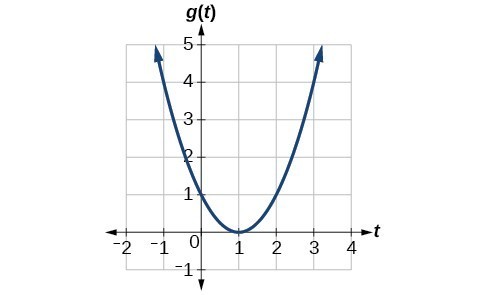
Effigy ane
Solution
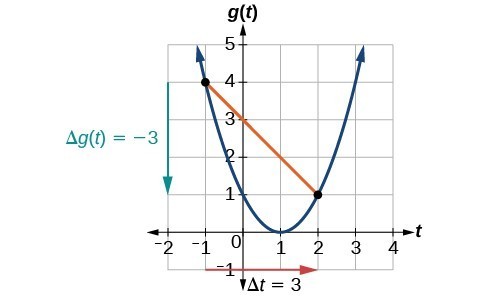
Figure 2
At [latex]t=-1[/latex], the graph shows [latex]g\left(-one\correct)=4[/latex]. At [latex]t=two[/latex], the graph shows [latex]g\left(two\right)=1[/latex].
The horizontal change [latex]\Delta t=3[/latex] is shown past the cherry-red arrow, and the vertical change [latex]\Delta g\left(t\right)=-3[/latex] is shown by the turquoise arrow. The output changes by –3 while the input changes by iii, giving an average rate of change of
[latex]\frac{one - iv}{two-\left(-1\right)}=\frac{-3}{3}=-1[/latex]
Analysis of the Solution
Notation that the society we choose is very important. If, for example, we utilize [latex]\frac{{y}_{2}-{y}_{one}}{{x}_{1}-{x}_{2}}[/latex], we will non get the right answer. Determine which betoken will be one and which betoken will be 2, and continue the coordinates stock-still as [latex]\left({x}_{1},{y}_{one}\right)[/latex] and [latex]\left({ten}_{2},{y}_{2}\right)[/latex].
Instance three: Calculating Boilerplate Charge per unit of Change from a Table
After picking up a friend who lives 10 miles away, Anna records her distance from home over time. The values are shown in the table beneath. Observe her average speed over the first 6 hours.
| t (hours) | 0 | 1 | two | 3 | 4 | 5 | vi | 7 |
| D(t) (miles) | 10 | 55 | xc | 153 | 214 | 240 | 282 | 300 |
Solution
Hither, the average speed is the average rate of change. She traveled 282 miles in 6 hours, for an boilerplate speed of
[latex]\brainstorm{cases}\\ \frac{292 - 10}{6 - 0}\\ {}\\ =\frac{282}{6}\\{}\\ =47 \end{cases}[/latex]
The average speed is 47 miles per hr.
Analysis of the Solution
Considering the speed is non constant, the average speed depends on the interval called. For the interval [two,3], the average speed is 63 miles per hour.
Example 4: Calculating Average Rate of Modify for a Function Expressed as a Formula
Compute the average rate of alter of [latex]f\left(x\right)={x}^{ii}-\frac{1}{ten}[/latex] on the interval [latex]\text{[ii,}\text{4].}[/latex]
Solution
Nosotros can start by calculating the function values at each endpoint of the interval.
[latex]\begin{cases}f\left(2\right)={2}^{2}-\frac{1}{two}& f\left(four\right)={4}^{2}-\frac{one}{4} \\ =4-\frac{1}{2} & =16-{1}{four} \\ =\frac{seven}{2} & =\frac{63}{4} \end{cases}[/latex]
Now we compute the average rate of modify.
[latex]\begin{cases}\text{Average charge per unit of alter}=\frac{f\left(4\right)-f\left(2\right)}{4 - ii}\hfill \\{}\\\text{ }=\frac{\frac{63}{four}-\frac{7}{2}}{4 - 2}\hfill \\{}\\� \text{ }\text{ }=\frac{\frac{49}{four}}{2}\hfill \\ {}\\ \text{ }=\frac{49}{8}\hfill \end{cases}[/latex]
The post-obit video provides another instance of finding the average rate of alter of a office given a formula and an interval.
Try It 2
Discover the average rate of change of [latex]f\left(x\right)=ten - 2\sqrt{10}[/latex] on the interval [latex]\left[1,nine\right][/latex].
Solution
Example 5: Finding the Average Charge per unit of Change of a Force
The electrostatic force [latex]F[/latex], measured in newtons, between two charged particles can be related to the distance between the particles [latex]d[/latex], in centimeters, by the formula [latex]F\left(d\right)=\frac{two}{{d}^{2}}[/latex]. Discover the boilerplate rate of change of force if the distance between the particles is increased from 2 cm to 6 cm.
Solution
We are computing the average rate of alter of [latex]F\left(d\right)=\frac{ii}{{d}^{2}}[/latex] on the interval [latex]\left[2,6\right][/latex].
[latex]\begin{cases}\text{Average rate of change }=\frac{F\left(half dozen\right)-F\left(2\correct)}{6 - ii}\\ {}\\ =\frac{\frac{2}{{half dozen}^{2}}-\frac{2}{{2}^{2}}}{6 - ii} & \text{Simplify}. \\ {}\\=\frac{\frac{2}{36}-\frac{2}{4}}{iv}\\{}\\ =\frac{-\frac{sixteen}{36}}{4}\text{Combine numerator terms}.\\ {}\\=-\frac{1}{ix}\text{Simplify}\cease{cases}[/latex]
The average rate of change is [latex]-\frac{1}{9}[/latex] newton per centimeter.
Example 6: Finding an Average Charge per unit of Change equally an Expression
Detect the average rate of change of [latex]thou\left(t\right)={t}^{two}+3t+i[/latex] on the interval [latex]\left[0,a\correct][/latex]. The answer will exist an expression involving [latex]a[/latex].
Solution
We employ the boilerplate charge per unit of change formula.
[latex]\text{Average rate of change}=\frac{1000\left(a\right)-g\left(0\correct)}{a - 0}\text{Evaluate}[/latex].
=[latex]\frac{\left({a}^{ii}+3a+1\right)-\left({0}^{ii}+3\left(0\right)+i\correct)}{a - 0}\text{Simplify}.[/latex]
=[latex]\frac{{a}^{2}+3a+i - i}{a}\text{Simplify and factor}.[/latex]
=[latex]\frac{a\left(a+3\right)}{a}\text{Split up past the common factor }a.[/latex]
=[latex]a+3[/latex]
This result tells united states of america the average charge per unit of change in terms of [latex]a[/latex] between [latex]t=0[/latex] and any other point [latex]t=a[/latex]. For example, on the interval [latex]\left[0,5\right][/latex], the average rate of change would be [latex]five+3=8[/latex].
Endeavour It three
Find the average rate of change of [latex]f\left(x\correct)={x}^{2}+2x - 8[/latex] on the interval [latex]\left[five,a\right][/latex].
Solution
Source: https://courses.lumenlearning.com/ivytech-collegealgebra/chapter/find-the-average-rate-of-change-of-a-function/
0 Response to "let ​ f(x)=x2+5x−8​. what is the average rate of change from x = 2 to x = 6?"
Post a Comment